
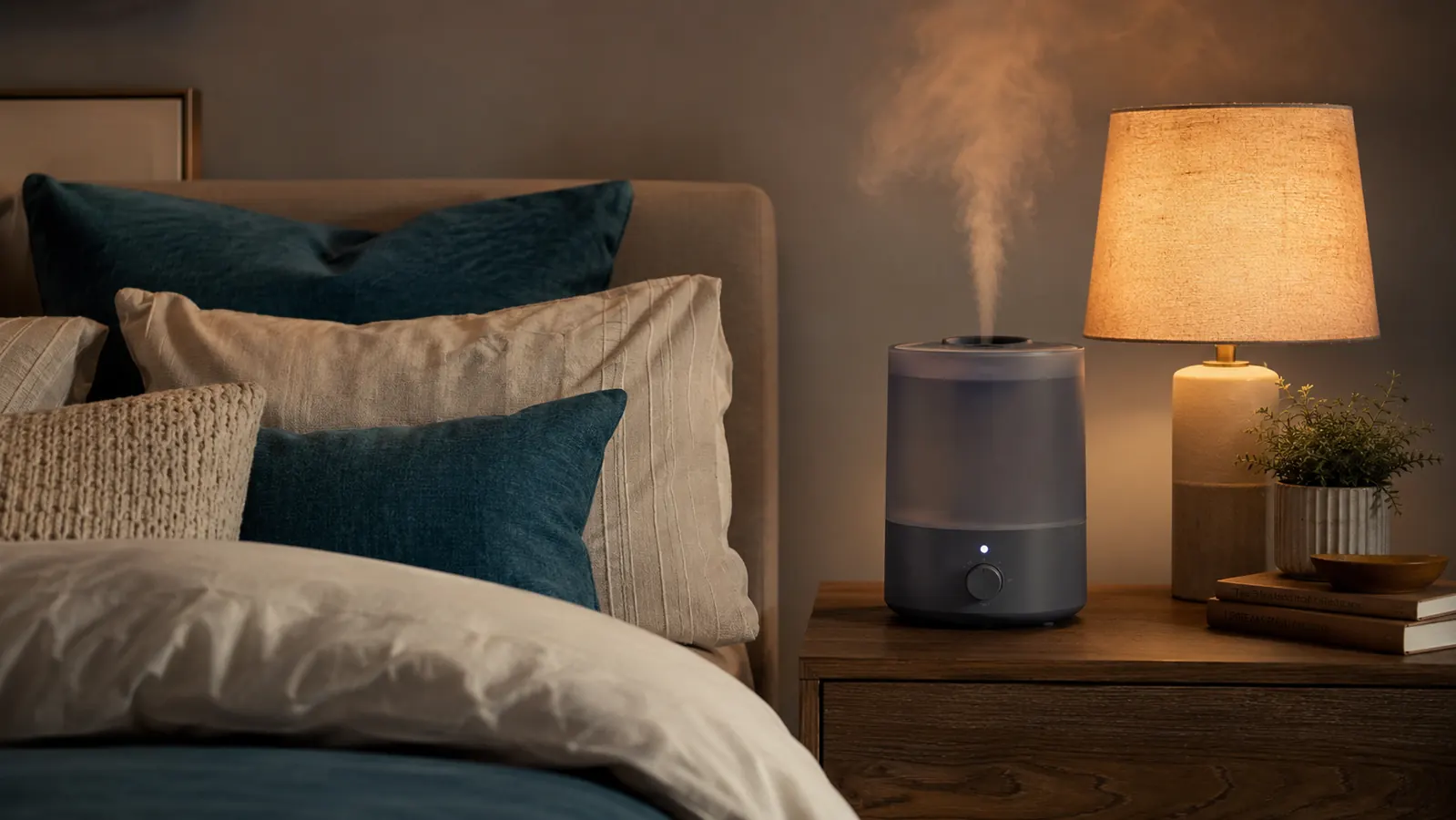
For two winters in a row I woke up almost every morning with a throat that felt like I'd swallowed sand. Chapped lips, a static shock every time I touched a doorknob, a nosebleed here and there. I blamed everything except the obvious thing, which was that my furnace was running all night and turning my bedroom air into something closer to the Sahara than a place a person sleeps. A friend who works in HVAC finally said the word out loud: humidity, not allergies, not a cold coming on, just plain dry air stealing moisture out of everything in the room, including me.
I bought a humidifier that same week, the AquaOasis cool mist model with the 2.2 liter tank, and for the first month it honestly didn't help much. Not because the machine was bad, but because I had it set up wrong, in the wrong spot, filled with the wrong water, running on the wrong setting. Once I fixed those five things, the difference was almost immediate, less like a placebo and more like someone had quietly swapped my bedroom air for a different climate. This is the setup I wish someone had handed me on day one instead of letting me figure it out the slow way over an entire winter.
Dry bedroom air is fixable in one evening
You don't need a whole-house system to stop waking up with a scratchy throat. A quiet cool mist humidifier sized for a bedroom does the job. The AquaOasis is the one I set up using the steps below.
Amazon Check Today's Price on Amazon →Step 1: Pick the Right Spot in the Room
This is the step that quietly ruins the whole setup for most people, myself included at first. I had mine sitting directly on my nightstand, six inches from my face, and woke up with a slightly damp pillow more than once. Mist that close to your head doesn't spread evenly through the room, it just dumps moisture in one small radius, which means the rest of the bedroom stays just as dry as before while your pillowcase gets soggy and your sheets pick up a faint mineral smell.
What actually works is placing the unit two to three feet off the floor, on a dresser or low shelf rather than the floor itself, and at least three feet away from your bed, the wall, and any electronics or wood furniture. Elevating it lets the mist disperse and settle evenly across the room instead of pooling in one spot. I moved mine to a low bookshelf on the far side of my bedroom and the difference in how evenly the air felt was noticeable within a day, less of a damp cloud in one corner and more of a general softness across the whole room.
Avoid corners and avoid tucking it behind curtains or furniture, both of which trap the mist in a dead pocket instead of letting it circulate. If your bedroom door stays open at night, a central spot roughly across from the doorway tends to distribute moisture the most evenly, since you're getting a little natural air movement helping it along. And keep it well clear of any wood furniture you care about, since prolonged direct mist exposure can leave a dresser top looking dull or slightly warped over months of nightly use.

Step 2: Use the Right Water, Not Just Whatever's Closest
I used straight tap water for the first few weeks because it was easy, and I started noticing a fine white dust settling on my nightstand and dresser. That's mineral residue, mostly calcium and magnesium, being carried out with the mist and drying on every nearby surface. It's harmless to breathe in small amounts but it's annoying to dust constantly, and over time it builds up inside the tank and on the ultrasonic plate too, which is what eventually makes a humidifier sound rattly or produce a weaker mist than it used to.
Switching to distilled water fixed the white dust completely. It costs a little more than tap water, obviously, since tap water is free, but a gallon jug lasts me close to two weeks of nightly use and it's a small price for not sneezing dust off my dresser every morning. If distilled water isn't practical for you, filtered water at least cuts the mineral load down noticeably compared to straight tap, especially if your area has hard water, which mine unfortunately does.
Either way, don't let water sit in the tank for more than a day or two without running it. Standing water is exactly the environment mold and bacteria like, and you do not want to be misting that into the air you breathe all night. If you're going to be away for a few days, I empty the tank completely rather than leaving it half full, since a half-empty tank sitting untouched is worse than either fully empty or freshly filled.

Step 3: Dial In Your Humidity Target Instead of Guessing
The sweet spot for a bedroom is 30 to 50 percent relative humidity. Below 30 and you're back to the dry throat and static shocks I started with. Above 50 and you're inviting dust mites, mold, and that slightly clammy feeling that makes it harder to fall asleep, not easier. Most people, me included, just run the humidifier and hope, with no idea what percentage they're actually landing on, which is basically like setting your thermostat blindfolded.
A cheap hygrometer, the kind that also reads temperature, fixed that guessing game for a modest investment. I keep mine on the same shelf as the humidifier so I can glance at both. When the room reads under 30 percent I run the AquaOasis on a higher mist setting for an hour or two before bed to bring it up, then drop it to low overnight once the room's caught up. Once you've watched the number for a week you start to get a feel for how long your specific room takes to recover, and you stop needing to check it every night, more like a monthly gut check than a nightly ritual.
Seasons matter here too. In the dead of winter with the heat running constantly, I check the hygrometer almost daily because the room dries out fast. In spring and fall, when the furnace isn't fighting me, I sometimes go a week between checks because the room holds its humidity so much longer on its own.

Step 4: Set the Mist Output and Night Mode Before You Turn In
Running a humidifier on high all night in a small bedroom is how you end up with condensation on your windows and that clammy-air feeling I mentioned above. I run mine on low overnight almost year-round now, and only bump it to medium or high for an hour before bed if the hygrometer is showing a really dry reading, then dial it back down before I actually fall asleep, which takes about ten seconds and has become as automatic as brushing my teeth.
The AquaOasis has a night light setting I keep switched off, mostly because even a soft glow is enough to bug me as a light sleeper, but if you like a dim nightlight in the room that's a nice option to have rather than running a separate lamp. It's genuinely quiet on low, quieter than a box fan, which matters if you're someone who's noise-sensitive like I am. If your unit has an auto shutoff when the tank runs dry, make sure it's actually working before your first full night, some units keep running dry and that's both a fire risk on ultrasonic models with a heating element and just bad for the machine over time.
The 2.2 liter tank on mine runs roughly 16 to 20 hours on low, which in practice means one evening fill gets me through the night with room to spare, even if I forget to top it off for a day. Knowing your unit's runtime on the setting you actually use, not just the marketing number on the box, saves you from waking up at 3 a.m. to a dry, silent machine that stopped helping hours earlier.
Step 5: Clean It on a Schedule, or It'll Work Against You
This is the step people skip until something smells off, and by then there's usually a thin film of buildup on the tank walls that's been getting misted into the air for a week or two without anyone noticing. I clean mine every three to four days with a simple mix of water and white vinegar, swishing it around the tank and the base reservoir, then a rinse and a soft brush scrub on the ultrasonic disc where mineral scale tends to collect first, usually with an old toothbrush I keep specifically for this.
Once a week I do a deeper clean, a longer vinegar soak for stubborn scale followed by a full air dry with the tank left open, since a wet, closed-up tank sitting overnight is prime mold territory. It sounds like a lot written out, but in practice it's about five minutes twice a week, and it's the single biggest factor in whether a humidifier helps your sleep or just becomes a musty smell you can't quite place coming from somewhere in the room.
If you ever do smell something faintly sour or see any discoloration in the tank, stop running it until it's been fully cleaned. Breathing in mold spores misted through the air defeats the entire purpose of trying to fix your sleep environment in the first place, and it's a genuinely easy mistake to make when you're tired and just want to fill the tank and go to bed.
What Else Helps
A humidifier is solving one specific problem, air that's too dry for your skin, sinuses, and throat to handle comfortably through eight hours of sleep, and once it's set up right it's one of the more noticeable, low-effort upgrades you can make to a bedroom. But it's not doing everything on its own. A room that's too warm will still leave you tossing and turning even at perfect humidity, so keeping the thermostat closer to 65 to 68 degrees overnight pairs well with it. If you have forced-air heat running constantly in winter, a humidifier is fighting an uphill battle every single night, so don't be surprised if you need it on a higher setting during the coldest stretches. A small houseplant or two won't replace a humidifier, but it does add a little baseline moisture and makes the room feel less sterile between fillings. And if you're dealing with ongoing sinus issues or a cough that isn't improving with better humidity over a couple of weeks, that's worth mentioning to a doctor rather than assuming the machine will eventually catch up on its own.
The humidifier isn't fixing your air quality by existing on a shelf. It's fixing it by being filled with clean water, aimed at the right spot, and actually cleaned on a schedule.
Ready to stop waking up with a dry throat
If you've been putting off dealing with dry bedroom air, the AquaOasis cool mist humidifier is the one I set up using the exact steps above, and it's still running on my dresser every night.
Amazon Check Today's Price on Amazon →