
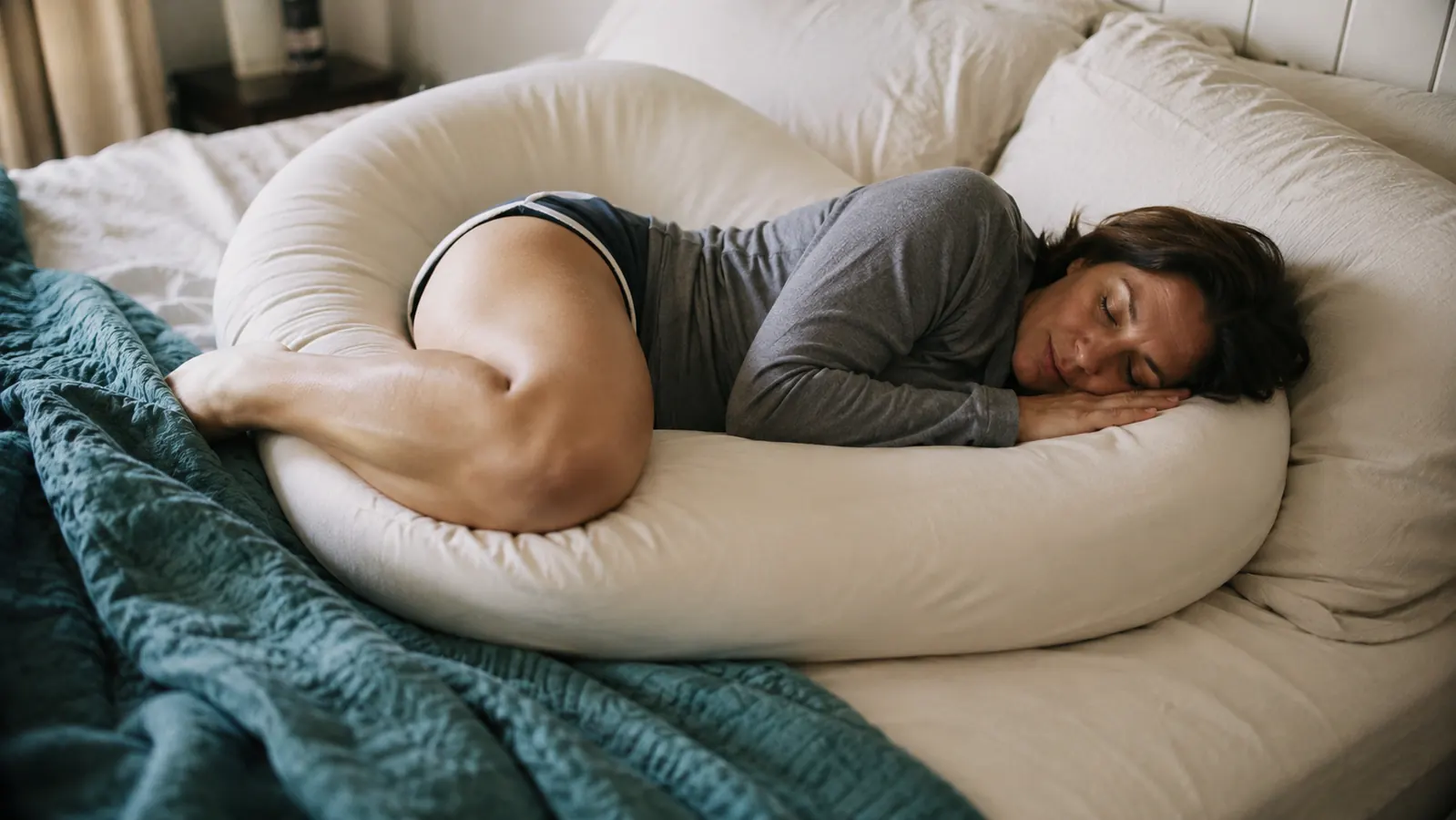
I used to wake up every morning doing this weird shuffle-limp to the bathroom while my lower back unlocked itself. Nothing dramatic had happened to it. No injury, no single bad night. It was just years of side sleeping with my top leg dead-weighting straight down onto my bottom leg, twisting my hips every single night for eight hours. A physical therapist finally asked me the obvious question I'd never bothered to answer: what was I actually doing with my legs and arms while I slept.
The answer, once I paid attention, was nothing helpful. I was stacking a regular pillow between my knees some nights, forgetting it by 2 a.m., and waking up flat on my stomach with my spine in a shape it never signed up for. Switching to a proper full body pillow, specifically the Queen Rose U-shaped pillow I still use, didn't fix my back pain overnight. What fixed it was learning to actually use the thing correctly. This guide is the setup I wish someone had shown me on night one instead of night sixty.
Stop propping three pillows and calling it support
A single U-shaped body pillow does the job of a knee pillow, a back bolster, and a chest hug pillow at once, which means less 2 a.m. pillow-Jenga and more actual sleep. The Queen Rose is the one I set up below.
Amazon Check Today's Price on Amazon →Step 1: Figure Out Which Kind of Back Pain You're Dealing With
Not all nighttime back pain comes from the same place, and the fix changes depending on where yours starts. If the ache sits low and centered, right around your belt line, it's usually your lumbar spine losing its natural curve when you lie flat or twist onto your stomach. If it's more off to one side, closer to your hip bone, that's often your SI joint getting torqued because your top leg is pulling your pelvis out of alignment while you side sleep. And if you get a hot, radiating line down the back of one leg, that's closer to sciatic irritation, where a body pillow helps but you also want to talk to a doctor if it's frequent.
I'm in the second camp, hip and SI joint, which is the single most common complaint I hear from readers too. The good news is a full body pillow addresses all three patterns reasonably well, because the root cause in every case is the same thing: your spine rotating or collapsing sideways for hours with nothing holding it in a neutral line. Knowing which one is yours just helps you know what to expect and how quickly.
It's also worth ruling out your mattress before you assume the pain is purely a positioning problem. If your mattress is more than seven or eight years old and you can feel a dip where your hips land, a pillow will help but it's fighting an uphill battle against a surface that's already pulling your spine out of line. I didn't replace my mattress, I just wanted to be honest that the pillow was doing extra work to compensate for a slightly saggy one, and it still made a real difference.
Step 2: Choose a Pillow Shape That Matches Your Sleep Position
This is the step most people skip, and it's why so many body pillows end up shoved in a closet after two weeks. A long straight body pillow works fine if you sleep on exactly one side all night and never move. Most of us aren't that person. I roll from my left side to my right side and occasionally end up half on my stomach, and a straight pillow just gets abandoned every time I flip.
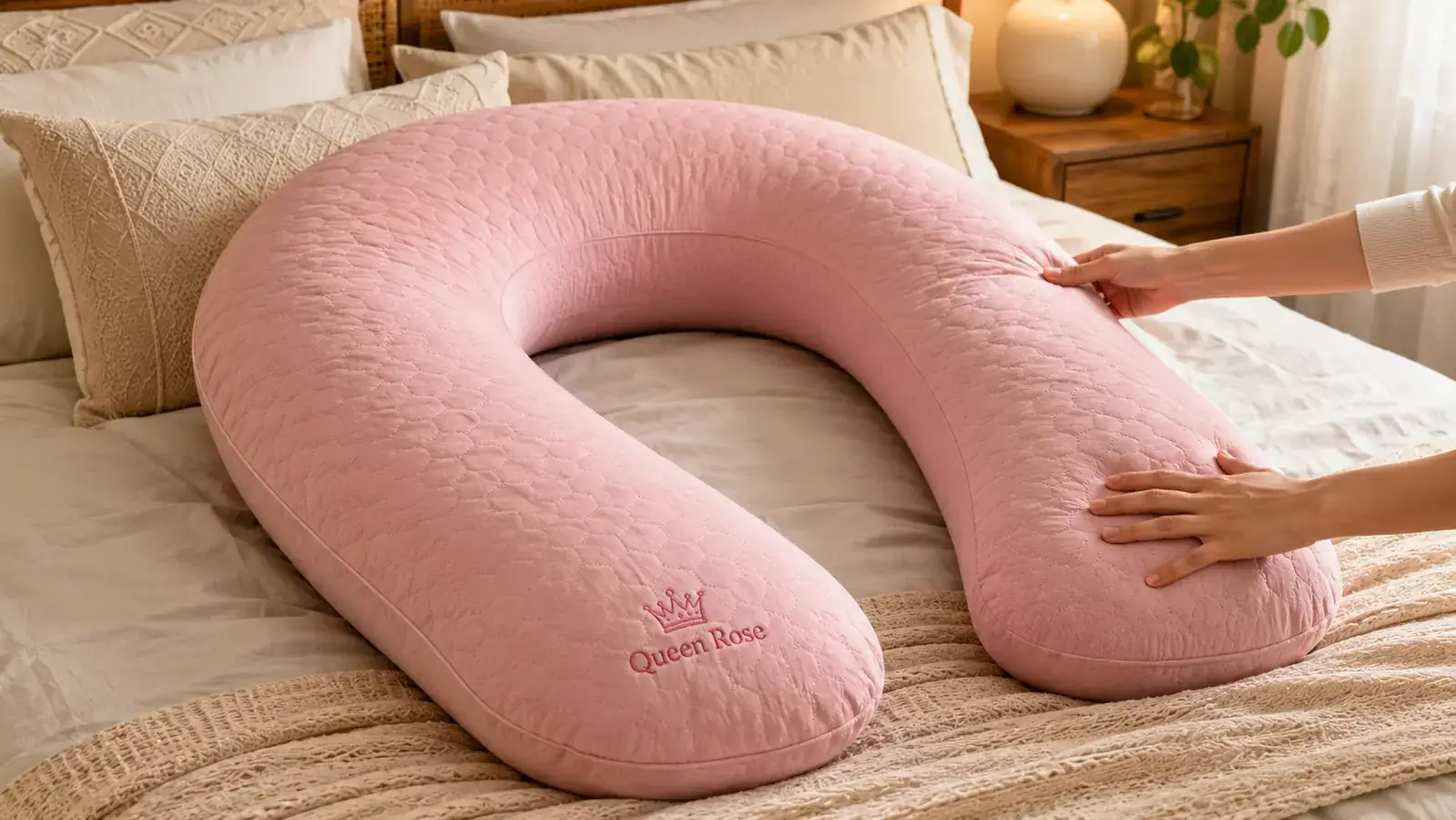
That's the specific reason I landed on a U-shaped pillow instead of a straight one. Because it wraps around both sides of your body, it doesn't matter which way you roll, the support is already there waiting for you. The Queen Rose is 55 inches, which is long enough that both arms of the U reach from roughly shoulder height down past my knees, so I'm not left dangling off the end of it like I was with a shorter 40-inch one I tried first.
If you're someone who genuinely never rolls over, a C-shaped or straight pillow is lighter, cheaper, and takes up less bed real estate, so I won't pretend the U-shape is the only right answer for everyone. But if you've ever woken up with a pillow on the floor and no memory of kicking it there, that's a sign you move more than you think, and the U-shape is built for exactly that kind of sleeper.
Step 3: Set Up the Pillow Correctly Before You Lie Down
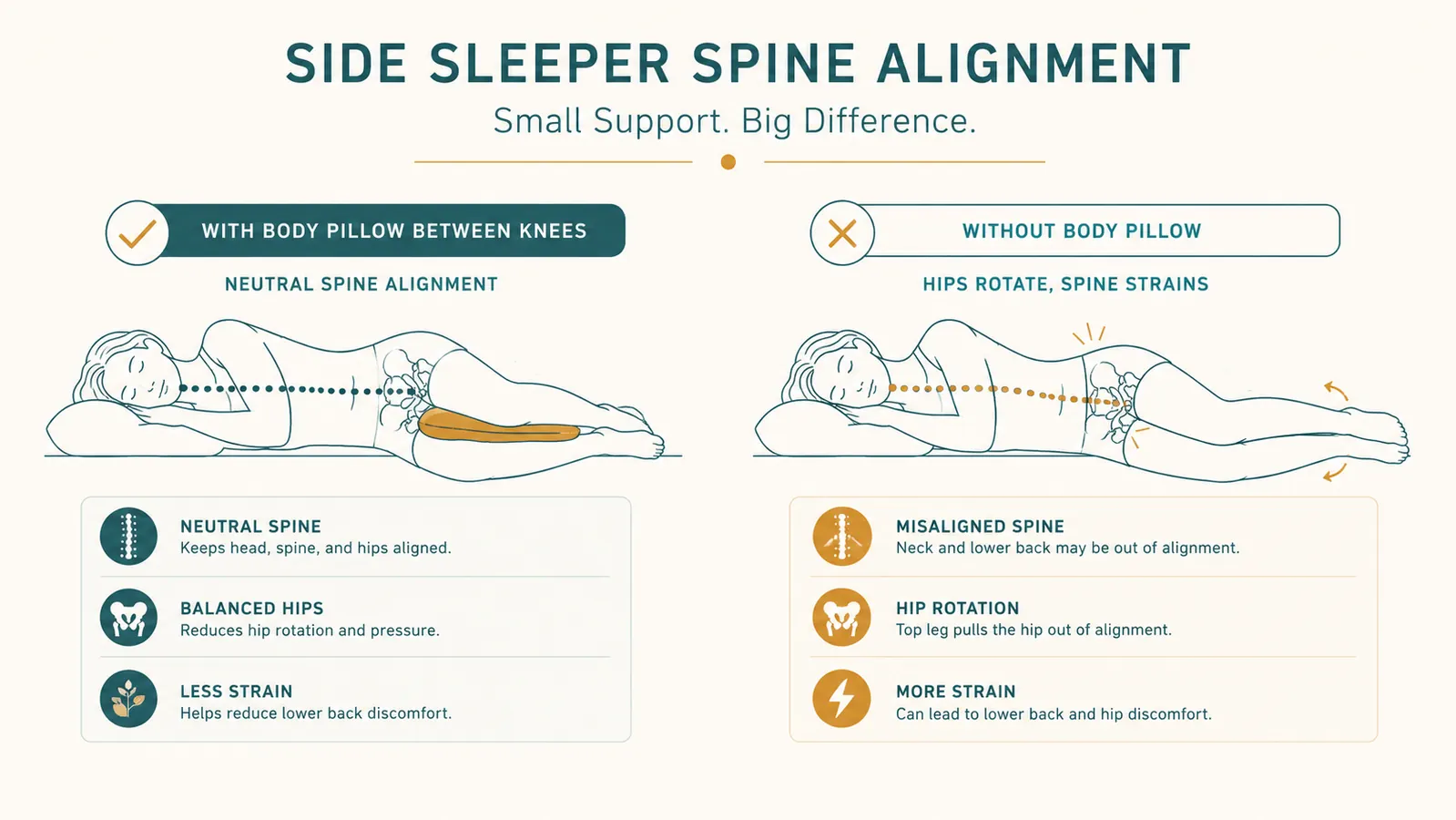
Here's the part nobody explains on the packaging. Lay the pillow down so the curved top sits where your head and neck will be, not your shoulders. Your head rests in that top curve almost like a horseshoe headrest, which keeps your neck from craning forward. From there, one arm of the U runs down your front, the other runs down your back.
Pull your top knee up and let it rest on the front arm of the pillow, roughly at a 30 to 45 degree bend, not clenched tight to your chest and not left almost straight. That knee angle is what actually levels your hips out. Then let your back settle against the rear arm so it's supporting your lower back and glute, not just resting empty behind you. Your top arm can drape over the front section or hug it lightly. The goal is a spine that stays in roughly the same straight line it would hold if you were standing with good posture, just tipped onto its side.
The first few nights it'll feel oddly bulky, almost like sleeping with a second person in bed. That sensation goes away fast. By about night four I stopped noticing the pillow was even there, which is honestly the whole point. One mistake I made early on was hugging the front arm too tightly against my chest, which actually rounded my upper back and pulled my shoulder forward. A loose drape works better than a tight grip, and if you're on the shorter side, folding a few inches of extra length back on itself instead of letting it trail past your feet keeps the whole shape more compact.

Step 4: Adjust the Fill and Position for Your Body
One thing that surprised me is how much a quick fluff changes the feel. The Queen Rose is filled with a soft polyester fiberfill that compresses over the first few weeks of use, especially under your knee and hip where you're putting real weight on it. I fluff mine by hand maybe twice a week now, working the filling back toward the compressed spots, and it holds its loft noticeably longer than it did when I was ignoring it.
If you're a heavier sleeper or you run hot, the fact that this one has a cooling silky cover actually matters more than it sounds like it would. I sleep hot and used to wake up sweaty just from having that much surface area of pillow against my skin all night. The cover doesn't make it cold, but it doesn't trap heat the way a plush microfiber one does either, which was enough of a difference that I noticed it within the first week.
If the knee section still feels too soft after a few weeks of fluffing and you're a bigger-framed sleeper, some people add a small firm pillow inside the loop for extra height. I haven't needed to, but it's worth knowing that's an option before you assume the pillow itself is the problem. On washing, I pull the cover off and machine wash it every couple of weeks and spot clean the inner fill, since tossing the whole thing in a home washer tends to clump the filling unevenly.
Step 5: Give It Two Full Weeks Before You Judge It
This is the step that saves the whole plan. Your body has spent months or years finding its own crooked way to fall asleep, and it takes a little time to unlearn that habit even when the new setup is objectively better for your spine. I almost gave up around night five because I kept unconsciously kicking the pillow out of position in my sleep and waking up back in my old twisted posture.
What changed it was sticking with the setup every single night instead of only when I remembered. By the second week my body stopped fighting it and started reaching for the knee support on its own, even half asleep. If you quit after three or four nights because it feels strange, you're stopping right before the part where it starts working. Track your morning stiffness on a scale of one to ten for two weeks and you'll usually see the trend line, even on the nights that felt rough.
A simple note on your phone works fine for this, one line each morning is enough. I didn't believe the pillow was helping until I scrolled back through two weeks of notes and saw my average had dropped from a six to a two. In the moment, night to night, the change is too small to feel. Over two weeks, it's obvious.
What Else Helps
A body pillow is doing one job, keeping your spine roughly straight while you're unconscious for a third of your day, and it's genuinely one of the highest-leverage, lowest-effort things you can do for nighttime back pain. But it's not magic, and I don't want to oversell it. A mattress that's sagging in the middle will undo a lot of the good the pillow is doing, because you're still sinking into a curve no pillow can fully counteract. A couple of minutes of hip flexor and glute stretching before bed makes a real difference too, since tight hips are part of why the knee wants to collapse inward in the first place.
Daytime posture matters more than people expect as well. If you sit hunched over a desk for eight hours and then ask a pillow to undo that at night, you're asking a lot of one piece of foam and fiberfill. I started standing up and stretching every hour at work around the same time I switched pillows, and I honestly can't fully separate how much credit belongs to each. If your pain is sharp, worsening, or waking you up several nights a week regardless of setup, that's a conversation for a doctor or physical therapist, not just a pillow swap.
The pillow doesn't fix your back. It just stops you from re-injuring it every night while your back fixes itself.
Ready to stop waking up crooked
If you've been meaning to try a proper body pillow instead of another regular pillow shoved between your knees, the Queen Rose U-shaped is the one I set up using the exact steps above.
Amazon Check Today's Price on Amazon →